



CQC Returning to Good and Outstanding GP Providers: Ensuring Quality and Clinical Assurance
Key Takeaways
- The Care Quality Commission (CQC) has introduced an enhanced assessment framework for GP practices rated Good or Outstanding, focusing on targeted clinical reviews.
- Enhanced assessments combine ten fixed non-clinical quality statements with two clinical areas: medicines optimisation and delivering evidence-based care.
- CQC clinical searches are conducted by GP Specialist Advisors or clinical pharmacists, requiring practices to maintain rigorous prescribing governance.
- Deploying structured ARRS clinical pharmacists through specialised primary care partners provides readymade governance without straining GP supervisory capacity.
- Proactive high-risk drug monitoring, MHRA alert reconciliation, and regular clinical audits ensure continuous inspection readiness.
Introduction
Primary care across the National Health Service operates under extraordinary operational demand, requiring general practices and Primary Care Networks (PCNs) to balance day-to-day patient care with stringent regulatory compliance. The Care Quality Commission (CQC) has rolled out an enhanced iteration of its Returning to Good and Outstanding assessment programme for NHS GP practices. Designed to evaluate lower-risk surgeries last inspected between 2017 and 2022, this initiative brings focused regulatory contact to practices that have not undergone a site visit in several years.
For Practice Managers, PCN Leads, and GP Partners, navigating these assessments with only five working days’ notice presents a distinct operational challenge. Returning to good and outstanding GP providers requires demonstrating that daily prescribing, long-term condition monitoring, and clinical governance match current single assessment framework standards. Understanding the mechanics of these enhanced inspections and structuring clinical workflows accordingly allows surgeries to showcase excellence while safeguarding workforce capacity.
The Enhanced Assessment Framework: What Has Changed?
The standard assessment under the Returning to Good and Outstanding programme focuses on ten non-clinical quality statements, accompanied by an on-site visit and key staff interviews. However, where CQC local inspection teams identify the need for deeper clinical assurance, an enhanced assessment is initiated.
From 30 July 2026 the CQC has started rolling out an “enhanced” version of the Returning to Good assessment for some practices. It is the same fixed ten quality statements, plus medicines optimisation and delivering evidence-based care and treatment with a GP Specialist Advisor or clinical pharmacist involved.
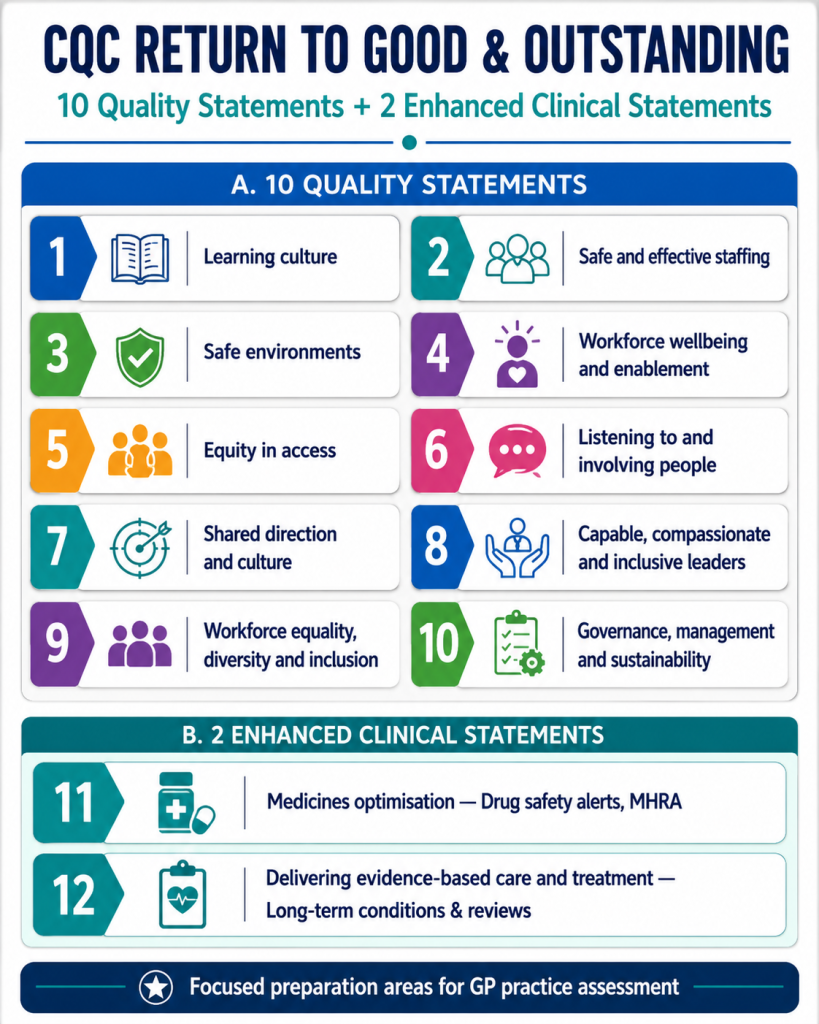
The enhanced model incorporates a routine clinical review of patient records led by either a CQC GP Specialist Advisor or a trained clinical pharmacist from the CQC Medicines Optimisation team. These clinical searches examine two pivotal quality statements:
- Medicines Optimisation (Safe Key Question): Evaluating how the practice manages high-risk drug monitoring, MHRA safety alerts, repeat prescribing protocols, and medication reconciliation.
- Delivering Evidence-Based Care and Treatment (Effective Key Question): Reviewing chronic disease management, long-term condition reviews, and adherence to national clinical guidelines.
Because inspectors evaluate the practice as it operates today rather than relying on historic performance surgeries must ensure their clinical records and safety searches are consistently up to date.
Operational Challenges Face Practices During Assessment
Maintaining comprehensive clinical governance across a busy general practice can be difficult amidst competing operational pressures. Several factors can introduce vulnerabilities when preparing for an enhanced CQC review:
- Leadership and Staff Turnover: Changes in clinical leadership, practice management, or nursing staff can lead to gaps in historic knowledge and policy ownership.
- Supervisory Burnout in Pharmacy Roles: Integrating non-medical prescribers under the Additional Roles Reimbursement Scheme (ARRS) often demands significant supervisory time from senior GP partners, diverting focus from strategic oversight.
- Backlogs in High-Risk Drug Audits: Clinical searches frequently expose overdue blood tests for patients prescribed high-risk monitoring drugs, such as direct oral anticoagulants (DOACs), disease-modifying antirheumatic drugs (DMARDs), ACE inhibitors, or lithium.
- Short Preparation Windows: Receiving five working days’ notice leaves minimal time for pre-inspection preparation, making continuous inspection readiness essential.
To assist surgeries in establishing robust governance, The Medicines Management Team (TMMT) provides specialised medicines management services utilising dedicated ARRS clinical pharmacists and pharmacy technicians. Rather than placing additional managerial duties on GP partners, TMMT supplies an integrated operational infrastructure designed around CQC standards.
A Good rating from previous years should reflect modern, active clinical assurance. When practices establish structured, pre-audited medicines governance, regulatory visits become a natural validation of everyday excellence rather than a source of operational stress.
TMMT embeds ready-made quality management structures aligned with ISO 9001 standards. By managing recruitment, credentialing, clinical supervision, and continuous peer audits, TMMT ensures that remote and practice-based pharmacy staff deliver immediate clinical value without exhausting local supervisory capacity.
How PCNs Across the UK Are Reacting to the New CQC Guidelines
The introduction of the CQC enhanced assessment has generated widespread discussion among Primary Care Network (PCN) leadership teams across the country. Surgeries rated Good or Outstanding several years ago are recognising that historic ratings do not guarantee compliance under current Single Assessment Framework criteria.
In response, PCNs are adopting several strategic operational adjustments:
- Moving Away from Reactive preparation: PCN leads are replacing short-term pre-inspection rushes with routine, monthly clinical record audits that mirror CQC clinical search parameters.
- Standardising Medicines Governance: Networks are establishing uniform Standard Operating Procedures (SOPs) across member practices to harmonise high-risk drug monitoring, repeat prescribing reauthorisations, and discharge reconciliations.
- Centralising Pharmacy Supervision: Rather than expecting individual GP partners to act as line managers and clinical mentors, PCNs are turning to managed infrastructure models to oversee their ARRS clinical pharmacists and pharmacy technicians.
This nationwide shift reflects a broader recognition: regulatory readiness must be an ongoing operational standard rather than an intermittent exercise.
Practice Perspectives: Feedback and Opinions on Partnering with TMMT
Feedback from healthcare staff on the ground indicates that when external clinicians are provided with written SOPs, clear bypass lines, and structured inductions, they integrate seamlessly into practice workflows. Practices value having a single point of clinical contact who becomes familiar with local formularies, referral pathways, and surgery staff, rather than rotating locum cover.
Capturing structured feedback from both staff and patients reinforces service quality. As TMMT Director Mohammed Rashad notes regarding clinical impact:
“I’ve always told my staff and clinicians: always get positive feedback in writing. Ask the patient to email the practice, leave a Google review, or provide feedback in whatever appropriate way is available. If you’re doing good practice, you should capture that… That’s why, as a company, whenever we receive good feedback, we pass it on to the practice and let the clinician know. We’ve also got an internal reward mechanism, such as ‘Pharmacist of the Month’ and ‘Pharmacist of the Year.’ These things are very important for building a good learning culture and recognising good practice.”
When practice staff notice palpable reductions in daily stress and empty appointment slots are effectively utilised, general practices validate that their primary care network collaboration is delivering true value to their community.
Conclusion: Maintaining Sustainable Regulatory Readiness
Navigating the framework for returning to good and outstanding GP providers requires shifting from periodic inspection preparation to embedded daily governance. By aligning clinical pharmacy workflows with CQC medicines optimisation standards, general practices protect patient safety, unburden senior prescribers, and maintain complete confidence in their service quality.
To discover how specialised clinical pharmacy support can enhance your practice’s operational resilience and regulatory assurance, explore the tailored solutions available at The Medicines Management Team.
Frequently Asked Questions
Local CQC inspection teams decide whether to conduct a standard or enhanced assessment based on information currently held, intelligence gathered during the planning stage, and the need for clinical assurance regarding medicines management.
Practices receive at least five working days’ notice prior to the site visit under the returning to good and outstanding programme.
The clinical searches and clinical record reviews are conducted by a CQC GP Specialist Advisor or a member of the CQC Medicines Optimisation team, typically a clinical pharmacist.
Yes. Remote clinical pharmacists working through structured partners like TMMT access practice IT systems securely to conduct Structured Medication Reviews, process discharge reconciliations, complete drug safety searches, and support prescribing governance.
No. General practices retain full legal responsibility for patient care under CQC standards. Working with an accredited partner ensures that processes, documentation, and audits meet the regulator’s standards.