


Why Can’t I Get a GP Appointment? Following the Money to Unlock Primary Care Capacity
Key Takeaways
- The GP appointment strain stems from structural primary care funding models, where capitation payments fail to match surging contact volumes.
- Ring-fenced NHS funding schemes like the Additional Roles Reimbursement Scheme (ARRS) offer vital financial resources, but require structured clinical workflows to deliver results.
- Unburdening GP consultation schedules requires systematically delegating routine medication reviews, discharge reconciliations, and acute prescribing tasks to specialized clinical staff.
- Deploying remote clinical pharmacists allows general practices to absorb high-volume prescribing administration, returning vital consultation slots to doctors.
- Partnering with a managed medicines management service eliminates recruitment friction, supervisory burdens, and workforce volatility for Primary Care Networks.
Introduction
For millions of patients across the United Kingdom, the daily challenge of securing a doctor’s appointment has become one of the most visible points of friction in modern healthcare. To the public, it often feels like a breakdown in frontline access; however, for Practice Managers, Primary Care Network (PCN) leads, and GP Partners, the appointment crunch is the predictable result of structural funding mechanisms, workforce constraints, and an uncapped surge in patient demand.
When you “follow the money” in primary care, the core conflict becomes clear. GP surgeries operate as independent contractor businesses delivering NHS services under a global capitation contract. Practices receive a fixed annual allocation per registered patient—adjusted for local demographics via the Carr-Hill formula regardless of whether that individual contacts the surgery once or twenty times a year. As patient longevity increases and multi-morbidity becomes the norm, annual contacts per patient have climbed dramatically, while core funding and full time doctor numbers have not kept pace.
This financial and operational imbalance leaves surgeries facing an endless influx of daily requests without the direct clinical capacity to fulfill them. Yet, addressing GP appointment availability does not always require finding non-existent doctors. By understanding where funding flows specifically through targeted initiatives like the NHS Additional Roles Reimbursement Scheme (ARRS), practices can restructure their clinical workflows to free up doctor appointments for the patients who need them most.
The 8 AM Patient Rush: How Digital Access Has Transformed the Dynamic
Historically, the primary point of friction in general practice access was the traditional 8 AM telephone queue. Patients called simultaneously as phone lines opened, leading to busy tones, long hold times, and widespread frustration.
From Phone Queues to Digital Submissions
With the national rollout of online consultation software and digital triage tools, the nature of the 8 AM patient rush has changed significantly:
- Increased Intake Velocity: Rather than waiting on hold, patients can submit detailed digital forms as soon as online portals open at 8:00 AM. This allows surgeries to capture structured patient information rapidly.
- Digital Queue Congestion: While digital tools improve initial access, they do not automatically create additional clinical time. Hundreds of digital requests can land in practice administration queues within minutes, transferring the physical bottleneck from the telephone system directly into the clinical software.
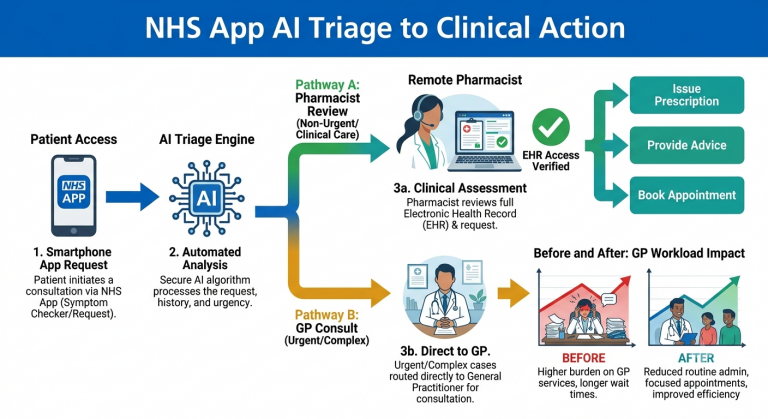
- Categorization and Routing: Digital tools categorize incoming requests, but qualified healthcare professionals are still required to review, action, and close each task. A significant proportion of these digital submissions involve repeat prescription adjustments, medication side effects, or routine monitoring queries.
Digitizing the front door of general practice has streamlined patient submission, but it highlights a fundamental reality: digital triage tools require an equivalent increase in clinical capacity to process incoming requests safely.
What Challenges GP Practices Face When Managing Appointment Demand and Pharmacy Roles
To understand “Why can’t I get a GP appointment?” From an operational standpoint, one must look at how a doctor’s time is actually spent during a typical clinic shift. A significant proportion of a GP’s daily workload is consumed not by complex diagnostic consultations, but by routine prescribing administration, medication reconciliations following hospital discharge, high risk drug monitoring audits, and triaging online consultation requests.
While NHS England established the Additional Roles Reimbursement Scheme (ARRS) to help PCNs recruit multidisciplinary staff including clinical pharmacists, paramedics, and physiotherapists, practices frequently encounter friction when trying to embed these roles effectively:
- The Recruitment and Retention Drag: Directly hiring individual clinical pharmacists often involves lengthy recruitment cycles, high salary competition, and sudden vacancies that leave practices with unexpected capacity gaps.
- Supervisory Overhead on GP Partners: Under standard employment models, embedded clinical pharmacists require daily clinical supervision, workplace queries, and ongoing line management. Senior GPs often find their own appointment slots consumed by supervising staff rather than seeing patients.
- Role Fragmentation: Without standardized operating procedures, in-house pharmacy staff are easily pulled into general practice administration, blunting their overall impact on prescribing safety and capacity.
How TMMT Supports Practices Operationally and Clinically
To bridge the gap between ring-fenced NHS funding and practical primary care capacity, The Medicines Management Team (TMMT) provides a fully managed clinical pharmacy delivery model. Rather than forcing surgeries to manage direct recruitment and daily supervision, TMMT supplies remote clinical pharmacists and pharmacy technicians who integrate seamlessly into practice workflows under the ARRS scheme.
By operating as a managed service partner, TMMT helps practices extract maximum value from their NHS primary care funding while protecting GP Partner time:
- Turnkey ARRS Compliance: All deployed staff are fully reimbursable under NHS England’s ARRS framework, ensuring PCNs utilize 100% of their available allocation without financial risk or practice co-funding.
- Independent Clinical Governance: TMMT provides senior, hub-backed clinical supervision for every deployed remote clinical pharmacist. Senior pharmacy leads conduct regular quality audits, manage clinical queries, and ensure adherence to local formulary guidelines, completely freeing GP Partners from daily supervisory duties.
- Dedicated Medicines Management Services: Remote pharmacy teams take complete ownership of high-volume prescribing tasks, including Structured Medication Reviews (SMRs), discharge reconciliations, high-risk drug monitoring, and digital triage prescribing queries.
Realistic Examples of Impact on Workflow and Patient Safety
Delegating routine medication tasks to dedicated pharmacy professionals yields immediate, measurable improvements in appointment availability and clinical safety.
Example 1: Streamlining Digital Triage Prescribing
A patient submits an online consultation request regarding mild side effects from an antihypertensive medication or a routine dose adjustment. Rather than populating an overbooked GP task list, the request is routed directly to a TMMT remote clinical pharmacist. The pharmacist reviews the patient’s renal function and blood pressure history in EMIS Web or SystmOne, conducts a telephone consultation, adjusts the medication, and updates the electronic record.
Outcome: The patient receives prompt specialist advice, and a GP consultation slot remains open for a complex diagnostic case.
Example 2: Post-Discharge Medication Reconciliation
An elderly patient with multiple long-term conditions is discharged from hospital with several altered medications. Within 48 hours of discharge, a TMMT pharmacist completes a comprehensive reconciliation, identifying a duplicate prescription and a missing monitoring blood test.
Outcome: Potential adverse drug events and hospital readmissions are prevented, while practice doctors are saved from time-consuming administrative cross-referencing.
Conclusion: Focus on Outcomes to Restore Primary Care Capacity
Following the financial and operational mechanics of primary care reveals a fundamental truth: answering the question Why can’t I get a GP appointment? is not about asking doctors to work harder. It is about structuring general practice so that doctors spend their time practicing medicine, while specialized clinical teams handle prescribing workflows.
By leveraging ARRS funding through a managed remote pharmacy model, Primary Care Networks can expand GP practice capacity, eliminate supervisory friction, and deliver timely, safe care to their patient populations.
Primary care leaders seeking to unburden their clinical workforce and optimize their ARRS allocations are invited to explore practical support options by visiting TMMT’s medicines management service page.
To better understand the structural pressures facing general practice and why patient access feels constrained despite hardworking surgery teams, watch this insightful video breakdown: Why Can’t I Get A GP Appointment? | It’s Not Your GP’s Fault. This video clearly explains the funding, recruitment, and workload realities shaping modern UK general practice.
Frequently Asked Questions (FAQ)
Appointment shortages are caused by a combination of rising patient contact volumes, an aging population with complex needs, and static core GP funding models that do not scale directly with daily demand.
The Additional Roles Reimbursement Scheme (ARRS) provides ring-fenced NHS funding for PCNs to employ healthcare professionals like clinical pharmacists, who take over routine prescribing and medication management, freeing up doctor appointments.
Remote pharmacists process hospital discharge reconciliations, manage repeat prescription queries, perform structured medication reviews, and action digital triage tasks directly within practice clinical systems.
No. TMMT provides independent clinical governance and supervision through experienced senior clinical leads, removing the supervisory burden from GP Partners.
Yes. Under NHS England regulations, PCNs can utilize their ARRS funding to secure clinical pharmacists and pharmacy technicians through managed service providers, provided all roles align with standard NHS descriptors.