

NHS Accelerates AI Rollout to Reduce Waiting Times: A Guide for Primary Care Leaders
Key Takeaways
- Strategic NHS Expansion: NHS England has launched a £10 billion technology investment strategy over three years, accelerating AI adoption across primary and secondary care.
- AI Triage in the NHS App: A new patient-facing triage tool adapts questions to direct individuals to the correct service, targeting nationwide coverage by April 2028 after a successful pilot that reduced phone queue demand by 29%.
- Ambient Voice Productivity: AI notetaking tools are being deployed to capture patient-clinician conversations in real time, freeing up to 25% more clinical time for direct patient care.
- Operational Capacity Challenges: While AI technology streamlines patient intake and documentation, GP practices require structured clinical capacity to action redirected workloads effectively.
- Maximising ARRS Value: Partnering with TMMT provides GP practices and PCNs with remote clinical pharmacists and pharmacy technicians, transforming digital efficiency gains into safe, repeatable patient outcomes.
Navigating Modernisation and Operational Pressure in Primary Care
For Practice Managers, Primary Care Network (PCN) leads, and GP Partners across England, balancing daily patient access with manageable clinical workloads remains a primary operational hurdle. The traditional morning phone rush, rising chronic disease prevalence, and administrative documentation burdens continue to stretch practice capacity. In response to these systemic challenges, NHS England announced a major digital transformation initiative where the NHS Accelerates AI Rollout to Reduce Waiting Times and enhance patient care across the health service.
Supported by £10 billion in government technology funding over three years, this national acceleration plan aims to deliver approximately half of the commitments outlined in the government’s 10 Year Health Plan. The broader initiative is projected to unlock £41 billion in health service benefits over the next decade by modernising digital infrastructure, automating routine administrative tasks, and streamlining patient triage.
However, for primary care leaders, technological innovation presents both an opportunity and a practical challenge. Deploying digital tools at scale alters how patients interact with general practice and how clinical information flows through surgery management systems. To convert national technology initiatives into sustainable local capacity, practices must establish robust clinical workflows capable of managing digital outputs efficiently.
The Background and Scope of the NHS AI Acceleration Strategy
The accelerated rollout focuses primarily on two transformative technologies designed to unburden frontline healthcare workers and improve patient navigation:
1. AI-Powered Patient Triage via the NHS App
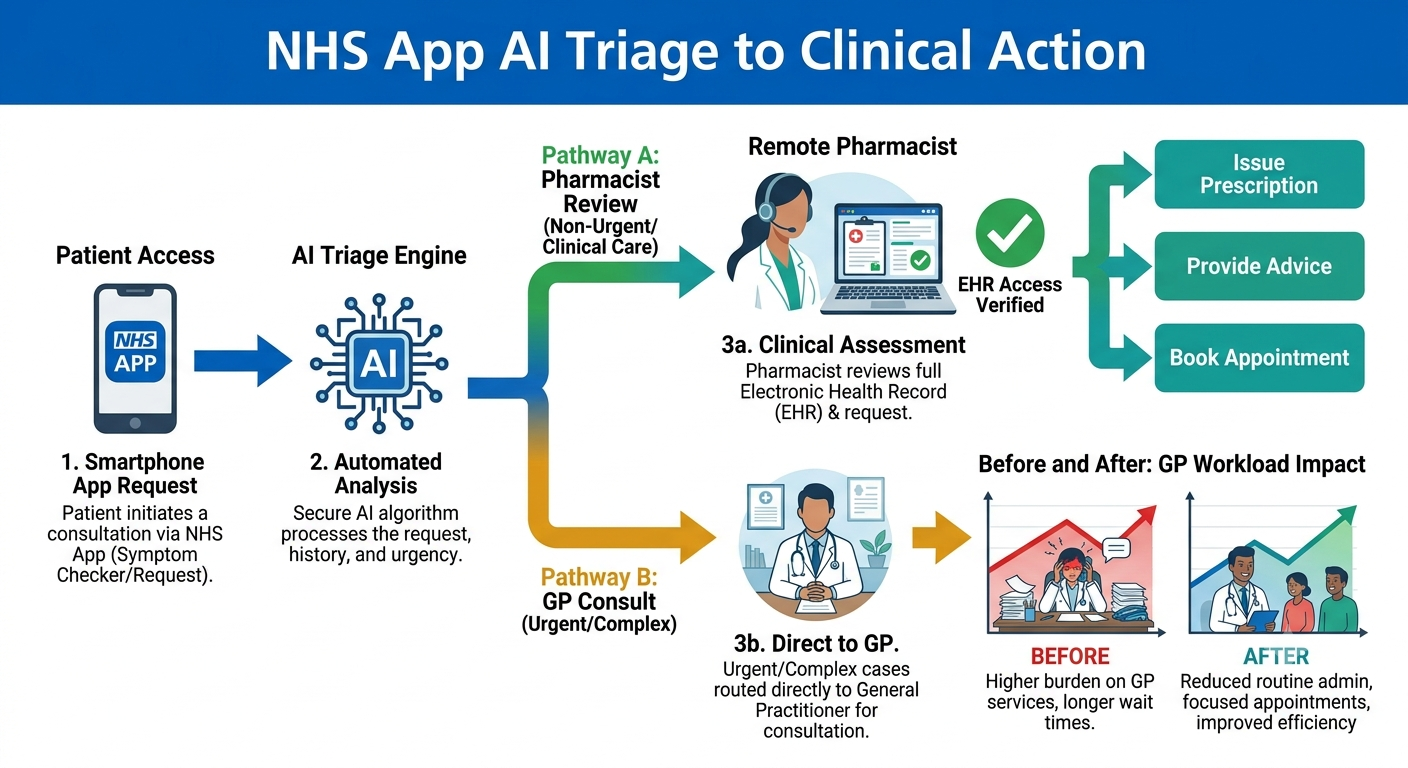
A core pillar of the announcement is the expansion of a national AI triage tool NHS App module. This intelligent system interacts directly with patients seeking care, adapting its line of questioning based on real-time responses to build a granular understanding of the patient’s underlying condition. It then directs the individual to the most appropriate service, whether a GP appointment, community pharmacy, urgent treatment center, or self-care advice.
Following an initial pilot at a general practice in Sussex, which demonstrated a 29% reduction in telephone queue volume without compromising patient satisfaction, NHS England plans to scale the technology to 200,000 patients over the next 12 months, with full national availability anticipated by April 2028.
2. Ambient Voice Technology and AI Notetaking
Alongside patient triage, NHS England is accelerating the deployment of ambient voice technology in primary care and hospital settings. These tools listen securely to patient-clinician consultations, producing real-time transcriptions and structured clinical summaries. Early evaluation trials, including those conducted across acute and primary care trusts, indicate that automated documentation can save clinicians up to 47 minutes per shift, returning up to a quarter of clinical consultation time back to direct patient care.
Key Stakeholder Perspectives
Senior health leaders have voiced strong optimism regarding the strategy. Sir Jim Mackey, Chief Executive of NHS England, noted that clinicians using ambient notetaking are already spending up to 25% more direct time with patients, reinforcing the decision to prioritize rapid adoption. Similarly, Preet Kaur Gill, Parliamentary Under-Secretary of State in the Department of Health and Social Care, emphasized that technology must serve to unburden healthcare professionals rather than slow them down.
Health and Social Care Secretary, James Murray, said: “As the NHS marks 78 years of serving patients, this investment shows how we can build on that proud legacy by embracing the technologies that will shape its future”
Dr Ragu Rajan from Wealden Ridge Medical Partnership in Sussex, which ran the initial trial of the AI triage tool in the NHS App, said: “As a rural practice serving 23,000 patients across four sites, we know how hard it can be for people to reach us.
“Integrating AI triage directly into the NHS App means our patients can tell us what they need, when they need it, and be directed to the right care first time. It hasn’t replaced our judgement – it’s given us back the time to use it.”.
At the same time, clinical commentators writing in the British Medical Journal have highlighted the importance of real world evaluation, robust governance, and ensuring that time saved on administrative duties directly translates into safe, high-quality clinical outcomes.
Challenges Facing GP Practices in Managing Technological and Workforce Changes
While national AI acceleration promises a welcome reduction in administrative friction, GP practices face distinct operational hurdles during implementation:
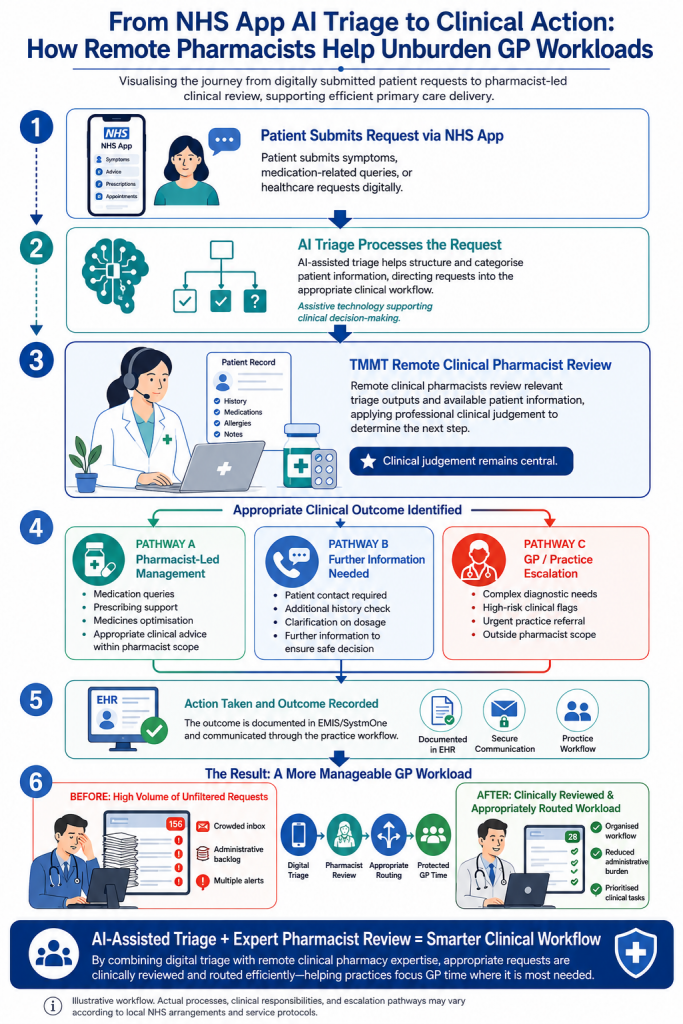
- Managing Shifted Triage Workloads: As AI triage tools re-route thousands of patient queries away from phone lines, a significant volume of these requests involves medication reconciliations, prescription re-authorisations, and minor ailments. Without dedicated clinical capacity to process these requests, practice backlogs simply shift from reception desks to clinician task lists.
- Recruitment and Retention Overhead: Practices attempting to build internal capacity often struggle with the administrative and financial costs of recruiting individual clinicians. Traditional independent recruitment through the Additional Roles Reimbursement Scheme (ARRS) frequently results in prolonged vacancy periods, management overhead, and disjointed onboarding.
- Supervision and Governance Requirements: Deploying new clinical roles or digital tools requires ongoing clinical oversight. GP Partners often find their own consultation schedules consumed by providing day-to-day supervision for newly embedded staff, blunting the overall capacity gains promised by technological tools.
As highlighted in TMMT’s insights on primary care workforce management, technology achieves its full potential only when paired with a structured, well-governed clinical workforce.
How TMMT Supports Practices Operationally and Clinically
To help general practice translate digital innovation into practical capacity, The Medicines Management Team (TMMT) provides a fully managed solution that pairs advanced clinical pharmacy support with existing practice infrastructure.
TMMT supplies remote ARRS clinical pharmacists and pharmacy technicians who integrate seamlessly into TPP SystmOne and EMIS Web environments. Because TMMT operates as a structured managed service, practices receive immediate, high-value clinical support without the management friction associated with direct recruitment.
Delivering Value Through Readymade Clinical Structure
- Zero Recruitment Overhead: TMMT handles the recruitment, vetting, and continuous professional development of all pharmacy staff, ensuring full compliance with NHS England’s ARRS framework so funding allowances are fully utilized.
- Dedicated Clinical Governance: Every TMMT pharmacist benefits from senior, hub-backed clinical supervision. This independent oversight ensures safe prescribing practices while protecting GP Partners from daily supervisory burdens.
- Targeted Medicines Management Services: Remote pharmacy teams take complete ownership of structured medication reviews, high-risk drug monitoring, discharge reconciliations, and incoming prescription tasks generated by AI triage systems.
By offloading routine prescribing administration to TMMT’s dedicated team, surgeries can lower their overall GP administrative workload, allowing doctors to focus on complex diagnostic consultations. Practices interested in optimizing their pharmacy workflows can explore TMMT’s full range of options on their medicines management services page.
Conclusion: Focusing on Outcomes and Sustainable Workforce Models
As national policy under the 10 Year Health Plan NHS framework continues to accelerate digital adoption, the central objective remains unchanged: delivering safe, timely, and effective care to patients. Technological innovations like AI triage and ambient voice tools offer powerful mechanisms to reduce administrative bottlenecks and streamline intake. However, technology alone is only half the equation.
To realize the full benefits of digital transformation, primary care leaders must pair smart technology with structured, high-performing clinical teams. By utilizing ARRS funding to deploy managed remote pharmacy services, GP practices and PCNs can unburden their GPs, protect practice capacity, and ensure every patient query receives expert clinical attention.
To discover how your surgery or PCN can build a resilient, outcomes-focused clinical workforce, explore the managed pharmacy solutions available through The Medicines Management Team.
Frequently Asked Questions
The AI triage tool integrates into primary care clinical workflows by adapting questions based on patient inputs. It then routes the structured information directly into the surgery’s clinical system (such as EMIS or SystmOne) or directs the patient to appropriate alternative care pathways like community pharmacy or self-care.
Yes. Under the NHS England Network Contract DES, PCNs can utilize their ARRS allocation to engage clinical pharmacists and pharmacy technicians provided by external managed service partners, provided all job roles meet standard NHS descriptors.
Ambient voice tools use encrypted, NHS-approved speech recognition software that transcribes consultation audio into structured summaries. Clinicians retain full control to review, edit, and approve all AI-generated notes before they are finalized in the patient record.
Remote clinical pharmacists process prescribing and medication queries generated by digital triage systems. This prevents routine prescription administration from overwhelming GP appointment schedules, returning valuable time to direct medical care.
TMMT enforces a rigorous governance framework where all clinical pharmacists work under the supervision of senior clinical leads, utilizing standard operating procedures, regular clinical audits, and secure NHS system connections.